Hypertrophic scars can be treated, but the right approach depends on the scar’s thickness, firmness, colour, age, and whether it is truly a hypertrophic scar or a keloid.
A hypertrophic scar is a raised, thickened scar that usually remains within the boundaries of the original wound. It may appear red or pink and can sometimes feel firm, itchy, or tight.
If the wound has fully healed but the scar remains raised or uneven, treatment options can be assessed. At Linery Wellness Center in Bangkok, Scar Regen is one option for scar remodelling after the scar has been properly evaluated.
Hypertrophic Scar Treatment at a Glance
- Hypertrophic scars can be treated, although results and treatment plans vary.
- They usually remain within the boundaries of the original wound.
- A scar that grows beyond the original wound may need to be assessed for keloid formation.
- Some hypertrophic scars gradually flatten over time, while others remain raised or firm.
- Treatment options may include silicone therapy, injections, laser-based treatments, or a combination of approaches.
- The scar’s thickness, texture, colour, age, and symptoms should be assessed before choosing treatment.
- Fully healed scars may also be assessed for Scar Regen when appropriate.
- Scars that continue to grow or resemble keloids should be medically assessed before treatment.
Insight Guide: Hypertrophic Scar Treatment: Options Before Scar Regen
What Is a Hypertrophic Scar?
A hypertrophic scar is a raised scar caused by excess scar tissue forming during the healing process. The scar may feel thick, firm, or elevated above the surrounding skin.
Unlike a keloid, a hypertrophic scar usually stays within the boundaries of the original wound.
Common Signs of a Hypertrophic Scar
- Raised above the surrounding skin
- Thick or firm texture
- Usually stays within the original wound
- May appear red, pink, or darker than the surrounding skin
- Can sometimes feel itchy, tight, or tender
- May gradually change as the scar matures
If a raised scar continues to grow beyond the original wound, it should be assessed to rule out a keloid.
Hypertrophic Scar vs Keloid: What Is the Difference?
Hypertrophic scars and keloids are both raised scars, but they are not the same condition. The main difference is how far the scar grows beyond the original wound.
| Feature | Hypertrophic Scar | Keloid |
|---|---|---|
| Raised above the skin | Yes | Yes |
| Stays within the original wound | Usually | Not always |
| Grows beyond the wound edges | Usually no | Can occur |
| May feel itchy, tight, or tender | Yes | Yes |
| May gradually flatten over time | Possible | Less likely |
| Requires separate assessment | Yes | Yes |
The clearest clue is the scar boundary. A hypertrophic scar generally remains within the original wound, while a keloid may extend into the surrounding skin.
If the scar continues to enlarge, grows beyond the original injury, or you have a history of keloids, a medical assessment is recommended before choosing a treatment.
What Causes Hypertrophic Scars?
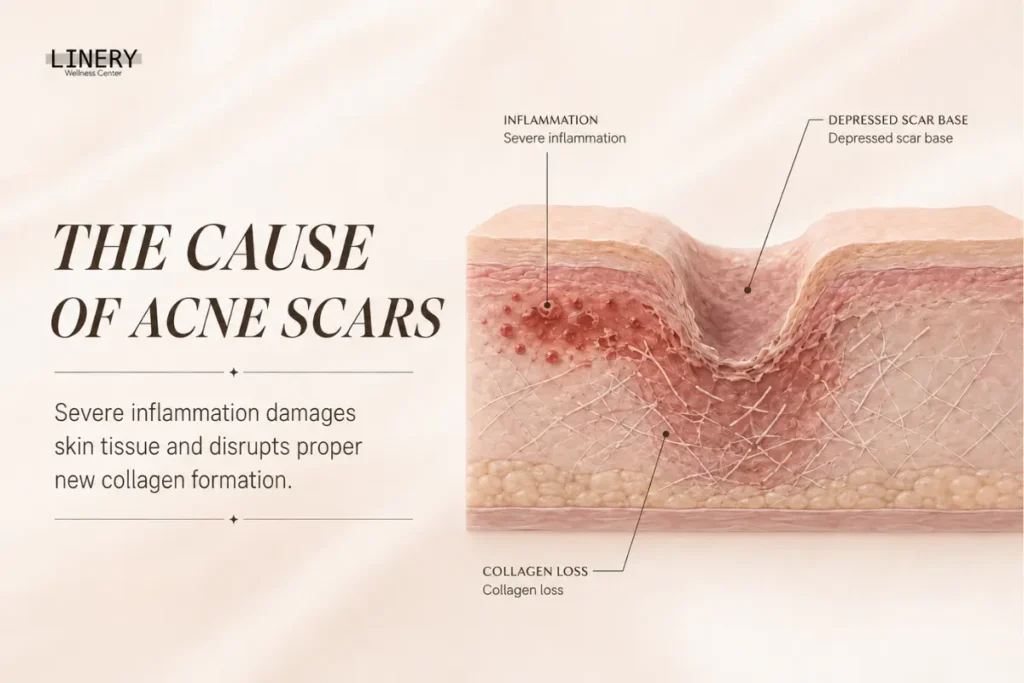
Hypertrophic scars develop when the skin produces excess scar tissue during wound healing. This can make the scar thicker, firmer, and more raised than the surrounding skin.
They may develop after surgery, injury, burns, or significant skin inflammation. The risk can vary depending on wound depth, tension on the skin, inflammation, and individual healing response.
How Does Wound Healing Lead to a Raised Scar?
When the skin is injured, the body produces collagen to repair the damaged tissue. If too much collagen is produced or the tissue remodels unevenly, the scar may become thick and raised.
Early scars may also appear red, pink, or firmer before changing as they mature.
What Can Increase the Risk of a Hypertrophic Scar?
Factors that may contribute include:
- Deep wounds
- Prolonged inflammation
- Delayed wound healing
- Infection
- High tension across the wound
- Repeated movement around the scar
- Individual differences in scar formation
Can Hypertrophic Scars Develop After Surgery?
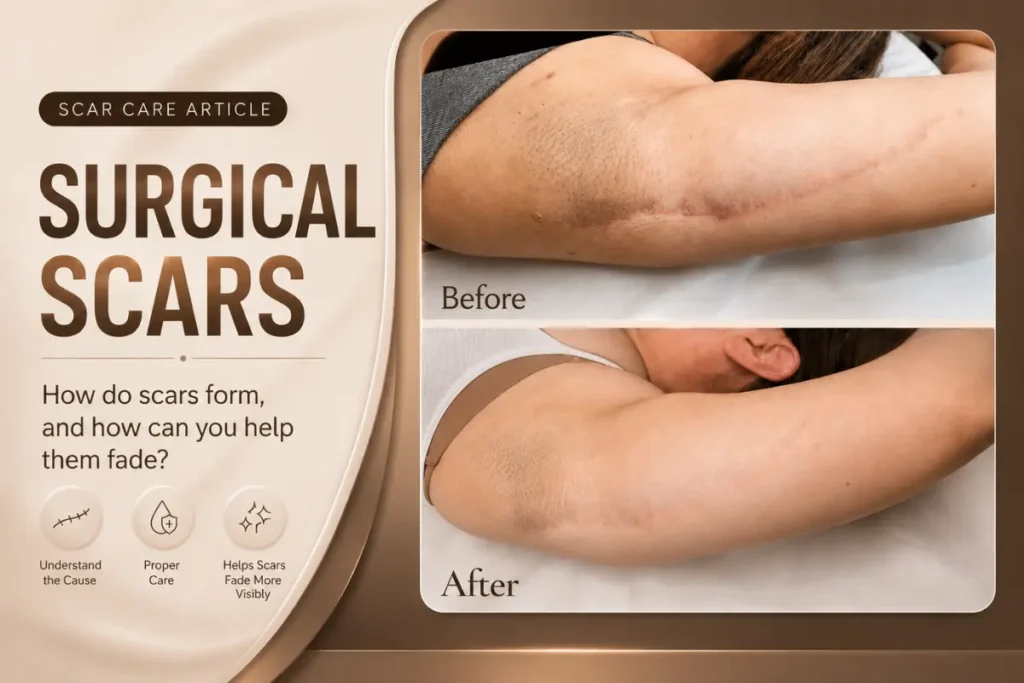
Yes. A surgical scar can become hypertrophic, especially in areas where the skin is under tension or the wound has been inflamed during healing.
For more detailed information about surgical scars, see our Surgical Scar Treatment guide.
Can Hypertrophic Scars Flatten on Their Own?
Yes, some hypertrophic scars may gradually become flatter, softer, and less noticeable over time, but not every scar will fully flatten on its own.
How much the scar changes depends on its thickness, age, location, skin tension, and individual healing response. If a scar remains raised, firm, or noticeable after it has matured, treatment options can still be considered.
Are New and Old Hypertrophic Scars Different?
Newer scars are still undergoing tissue remodelling and may initially appear red, firm, or more raised before gradually changing.
Older hypertrophic scars can still be treated, but the treatment plan should be based on the scar’s current thickness, firmness, colour, and texture.
When Should You Stop Waiting for the Scar to Flatten?
Consider a professional assessment if the scar:
- Remains thick or firm
- Becomes increasingly painful or itchy
- Continues to enlarge
- Extends beyond the original wound
- Has not noticeably changed over time
A scar that grows beyond the original wound should also be assessed to determine whether it may be a keloid rather than a hypertrophic scar.
Can Creams, Gels, and Silicone Help Hypertrophic Scars?
They can help in some cases, especially when the scar is still maturing, but results depend on the scar’s age and characteristics.
These products may help keep the scar hydrated, reduce tightness, and improve softness. However, thicker or older raised scars may need additional treatment beyond topical care.
How Can Silicone Gel or Silicone Sheets Help?
Silicone gel and silicone sheets are commonly used for raised scars. They help maintain hydration and may gradually improve scar softness and thickness in some cases.
They should only be used once the wound has closed and healed sufficiently, according to medical advice.
How Much Can Regular Scar Creams Help?
Scar creams may support hydration, skin comfort, and colour improvement, but their effect on the actual raised structure of a hypertrophic scar may be limited.
If the main concern is persistent thickness or firmness, topical products alone may not be enough.
When Might Topical Treatment Not Be Enough?
If the scar remains thick, firm, itchy, tight, or unchanged over time, it may be worth considering a professional assessment.
Once the wound has fully healed, other medical treatments or scar-remodelling options may be considered depending on the scar structure.
What Treatment Options Are Available for Hypertrophic Scars?
Hypertrophic scars can be treated in several ways depending on the scar’s thickness, firmness, colour, age, and symptoms. Treatment may involve silicone therapy, injections, laser-based procedures, or a combination of approaches.
Intralesional Injections
Doctors may use injections directly into the scar to help reduce thickness, firmness, or symptoms such as itching.
Not every raised scar requires injections. Suitability depends on the scar type and how active or mature the scar is.
Laser Treatment
Certain lasers may help improve redness, texture, or the overall appearance of a hypertrophic scar.
The choice of laser and treatment settings should be based on the scar characteristics and skin type, as not every laser is suitable for every scar.
Combination Treatment
Some scars have more than one concern, such as thickness, firmness, uneven colour, and irregular texture.
In these cases, more than one treatment may be considered to address different aspects of the scar rather than relying on a single procedure.
Scar Remodelling Programs
For fully healed scars that remain uneven or structurally irregular, scar-remodelling options may also be considered.
At Linery Wellness Center, Scar Regen is one option that can be assessed depending on the scar type, depth, and age.
What Should Be Assessed Before Treating a Hypertrophic Scar?
Before treatment, the scar should be assessed for its type, thickness, firmness, colour, age, and whether it stays within the original wound. These factors help determine which treatment approach may be appropriate.
Does the Scar Stay Within the Original Wound?
A hypertrophic scar usually remains within the original wound boundary.
If the scar extends beyond the wound or continues to enlarge, it should be assessed for possible keloid formation.
How Thick or Firm Is the Scar?
A mildly raised scar may require a different approach from a scar that is thick, hard, or tightly contracted.
Scar thickness and firmness can affect whether topical care, medical treatment, or scar remodelling should be considered.
What Does the Scar Look and Feel Like?
Colour, texture, itching, tenderness, and tightness can provide useful information about how the scar is behaving.
How Old Is the Scar?
Newer scars may still be changing as part of the natural healing process, while older scars may have a more stable structure.
Assessing these features before treatment helps avoid choosing a procedure based only on the fact that the scar is raised.
What Is Scar Regen and How Does It Support Scar Remodelling?
Scar Regen is a scar-remodelling program that uses ISR (Inkless Scar Revision) with microneedling to help improve scar texture and structure.
Before treatment, the scar is assessed based on its type, depth, and age to determine whether the program is appropriate.
For a fully healed hypertrophic scar, Scar Regen may be considered after assessment. If the scar extends beyond the original wound or may be a keloid, medical evaluation is recommended first.
Frequently Asked Questions About Hypertrophic Scar Treatment
Can hypertrophic scars be treated?
Yes. Treatment depends on the scar’s thickness, firmness, colour, age, and whether it is a hypertrophic scar or a keloid.
Options may include silicone therapy, medical treatments, or scar-remodelling procedures.
Can hypertrophic scars flatten on their own?
Some can. Certain hypertrophic scars gradually become flatter and softer as they mature, but not every scar will fully flatten without treatment.
If the scar remains raised or firm, further assessment may be helpful.
Are hypertrophic scars the same as keloids?
No. A hypertrophic scar usually stays within the original wound, while a keloid can grow beyond the wound edges.
A scar that continues to enlarge should be medically assessed.
Can old hypertrophic scars still be treated?
Yes. Older scars can still be assessed for treatment.
The treatment plan depends more on the scar’s current thickness, firmness, colour, and texture than on age alone.
Can silicone gel flatten a hypertrophic scar?
It may help in some cases, particularly while the scar is still maturing.
For thick, firm, or long-standing scars, silicone alone may not be enough.
Does every hypertrophic scar need injections?
No. Intralesional injections are one treatment option, but they are not necessary for every raised scar.
The decision depends on the scar’s characteristics and symptoms.
Can a raised surgical scar be treated?
Yes. Once the wound has healed sufficiently, a raised surgical scar can be assessed for appropriate treatment.
For more information about surgery-related scars, see Surgical Scar Treatment.
Can hypertrophic scars be treated with Scar Regen?
Scar Regen can be considered after assessment if the wound has fully healed and the scar is suitable for the program.
If the scar grows beyond the original wound or may be a keloid, medical assessment is recommended before treatment.
Conclusion: Hypertrophic Scar Treatment Starts With the Right Assessment
Hypertrophic scars can be treated, but the first step is to confirm the scar type and distinguish it from a keloid.
Treatment should consider the scar’s thickness, firmness, colour, age, texture, and symptoms. Options may include silicone therapy, injections, laser-based treatments, or scar-remodelling procedures.
For fully healed scars, Scar Regen may be considered after an assessment of the scar type, depth, and age.
If the scar continues to grow beyond the original wound or may be a keloid, medical assessment is recommended before choosing a treatment.
Results may vary from person to person. Please consult a physician for advice appropriate to your individual condition.
References
- American Academy of Dermatology (AAD) — Scar diagnosis and treatment, including silicone therapy, injections, and laser options
- American Academy of Dermatology (AAD) — Scar signs and symptoms, including raised scars and keloids
- DermNet New Zealand – Keloid and hypertrophic scars: characteristics, causes, and treatment approaches
- Cochrane – Laser therapy for hypertrophic and keloid scars
- PubMed – Evidence on silicone gel for the prevention and treatment of hypertrophic scars