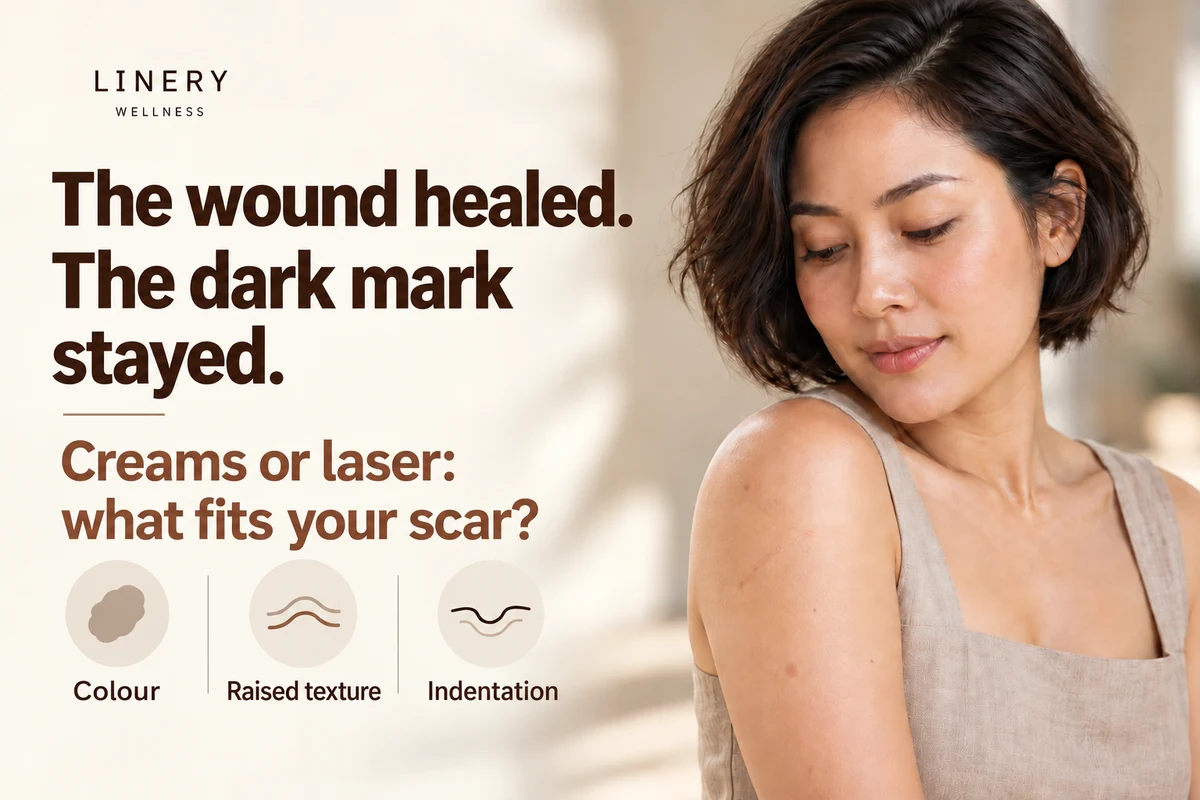
A dark mark may need pigment care, scar treatment or both. Pigment-focused creams can help selected pigment concerns, but they do not flatten raised tissue or fill a pit. Start by checking the texture as well as the colour; laser treatment is not necessary for every mark and cannot promise complete scar removal.
Wait until the wound has closed and the skin has healed before treating the remaining mark. An open, weeping or persistently crusted wound needs assessment before cosmetic treatment.
The 30-second summary
- For a mostly colour-related concern, start with irritation control and sun protection on healed skin.
- For a raised, indented, firm or tight area, have the scar tissue assessed as well as the pigment.
- Before laser treatment, ask what it will target and how the risk of further darkening will be managed.
- Track colour, texture and symptoms separately; fading colour does not mean the scar tissue has gone.
Insight Guide: Dark Scar Treatment: Should You Use Creams or Laser?
Is it a dark mark, scar tissue or both?
Post-inflammatory hyperpigmentation, or PIH, is darkening left after skin inflammation or injury, such as acne, an insect bite, a rash or a graze. A scar is tissue formed as a wound repairs. Pigmentation and scar tissue can occur in the same place.
Colour alone cannot tell you whether a cream or laser is appropriate. The skin’s texture and the history of the mark matter too. Use these observations to prepare for a consultation, rather than to diagnose the mark yourself.
| What you notice | What it may involve | What needs assessment |
|---|---|---|
| A brown or dark patch with texture similar to the surrounding skin | Pigmentation after inflammation may be the main issue | The cause of the colour and any continuing inflammation |
| A fairly flat mark along an old wound, with a different colour | A true scar with a pigment change | Both colour and tissue; a flat mark can still be a scar |
| A dark mark that is raised, indented, firm or tight | Changes in scar tissue as well as colour | Separate goals for pigmentation, height, indentation or tightness |
If acne has left pits as well as dark marks, our guide to acne scar types and treatment options covers those structural concerns. This article focuses on dark marks after healing rather than the treatment of each acne-scar type.
What should you do once the wound has healed?
Start by reducing repeated irritation, including picking, scratching and harsh scrubbing. If acne, a rash or another inflammatory condition is still active, that needs attention alongside the mark it leaves behind.
Protect exposed skin with clothing and a broad-spectrum sunscreen of SPF 30 or higher. Follow the reapplication instructions, including after sweating or swimming. Sun protection supports pigment care; it does not remove scar tissue.
If you have recently had a skin procedure, follow the treating clinician’s aftercare instructions before restarting products. Do not add exfoliating acids or dark-spot treatments while the skin is still irritated.
Choose care for colour or for scar texture
Dark-spot products target colour
A pigment-focused product or prescribed topical treatment may be an option. Azelaic acid is one example used for some dark marks. The choice should reflect the cause, treatment site and your skin’s tolerance, rather than simply the product’s strength. A pigment treatment should not be expected to flatten a raised scar or fill an indentation.
The label “scar cream” does not tell you whether a product targets colour or scar tissue. Check its ingredients and intended use, and avoid unlabelled products or lightening creams with unclear ingredients. If a product causes burning, peeling or increasing redness, stop using the irritating product and seek advice.
A mark on your face and one on your leg may need different products, even when the colour looks similar. Before reusing a treatment on another site or over a large area, check with a clinician or pharmacist. Mention medicines you use, and pregnancy or breastfeeding if relevant.
Silicone has a different role in scar care
Silicone gels and sheets have a role in scar care, particularly for raised scars after the wound has closed. They are not a default pigment treatment for every dark mark and do not fill a depressed scar. Tell your clinician if a silicone product causes a rash or skin breakdown.
If the colour fades but the scar remains raised, firm, itchy or tight, reassess the treatment goal rather than adding more pigment products. A clinician may consider treatment directed at the type of scar tissue. Our raised-scar guide explains what to discuss.
Could laser treatment help, or make the mark darker?
Lasers or chemical peels may help selected pigment concerns, but injury or irritation from a procedure can also worsen pigmentation. The type and location of the pigment, scar characteristics and your previous skin reactions all matter, especially if earlier procedures have left darker marks.
Before agreeing to a procedure, establish its target. A texture treatment is not automatically suitable for pigmentation alone, and a pigment-focused laser may leave height or tightness unchanged. Ask:
- Does this device and technique target pigment, texture or a particular scar symptom?
- Could skincare or a prescribed topical treatment be a starting point, and why is a procedure recommended now?
- What is the risk of darker or lighter patches for my skin, and how would a problem be managed?
- What aftercare will I need, when will the result be reviewed, and how will further treatment be decided?
A laser may make a scar less noticeable, but it cannot erase scar tissue completely. Some plans involve more than one treatment. Tell the clinician about a recent tan or sunburn before your appointment, as the timing may need to change.
How long can fading take, and what about old marks?
Some pigmentation fades over months once the cause of inflammation has stopped. Deeper pigment may last much longer. The darkness of a mark or a photograph alone cannot establish a precise timeline. Scar tissue changes through its own healing process, so fading colour does not mean the scar has gone.
A mark that has been present for years should be assessed for pigmentation, scar tissue or another cause before you try stronger products. Its age alone does not determine the appropriate treatment or the amount of improvement to expect.
Use photographs taken in similar lighting and from the same angle to discuss progress. Check three outcomes separately: whether the colour is lighter, whether the tissue feels softer, and whether tightness or pain has changed. This keeps a change in colour from being mistaken for a change in the scar itself.
When should a clinician examine the mark?
Increasing swelling, warmth or pain, pus, or fever calls for prompt medical assessment rather than routine dark-spot care. A scar-like mark that appears without a remembered injury should also be examined before cosmetic treatment.
A scar that is growing, persistently itchy or painful, or restricting movement needs assessment of the tissue as well. Do not wait only for the colour to fade.
How can Linery assess a dark scar?
Linery offers Scar Regen for scar concerns, with suitability assessed individually. Pigmentation alone may need a different approach from a programme directed at scar tissue. The description “dark scar” is not enough to choose a programme.
Explain what caused the mark, how long it has been there, whether colour or texture bothers you most, and which products or procedures you have tried. Mention any allergy, irritation or further darkening after treatment.
Linery’s procedure pricing starts at THB 3,000 for the treatment area. Ask for the area boundaries, inclusions and cost of your proposed plan to be confirmed. The starting figure does not specify the number of appointments or the total cost of your plan.
References
- American Academy of Dermatology: How to fade dark spots
- American Academy of Dermatology: Scar signs and symptoms
- American Academy of Dermatology: Scar diagnosis and treatment
- American Academy of Dermatology: What to know before laser scar treatment
- DermNet: Postinflammatory hyperpigmentation
- NHS: Scars
- NHS: Cuts and grazes