What Are Acne Scars, and How Are They Different from Post-Acne Marks?
Acne scars result from structural changes in the skin following inflammatory acne. When the skin’s repair process produces an imbalance in collagen, the affected area may develop depressed or raised scars that remain visible after the acne has healed.
Red or dark post-acne marks, on the other hand, usually involve changes in skin colour after inflammation. The surface often remains relatively level with the surrounding skin, so these marks are not necessarily structural acne scars.
Distinguishing between these concerns is important because post-acne discoloration and acne scars require different treatment goals. Choosing a treatment based only on the colour of a mark may overlook changes in the underlying skin structure.
| What You See | Likely Concern | Is It a Depressed Acne Scar? |
|---|---|---|
| Red or pink mark after acne | Post-inflammatory colour change | No |
| Brown or dark mark | Post-inflammatory pigmentation | No |
| Small pit or depression | Loss or alteration of skin structure | Yes |
| Wavy or broad depression | May involve underlying tissue tethering | Yes |
| Raised area above the skin | Excess scar tissue formation | Different type of scar |
If the skin remains flat and only the colour has changed, it may not require the same approach as a depressed acne scar. When the skin is visibly indented or creates noticeable shadows under angled light, further assessment of the scar structure may be useful.
Expert Insight: Post-acne discoloration and depressed scars often occur in the same area. A dark mark sitting over a depression does not necessarily mean pigmentation is the only concern, so both skin colour and texture should be assessed together.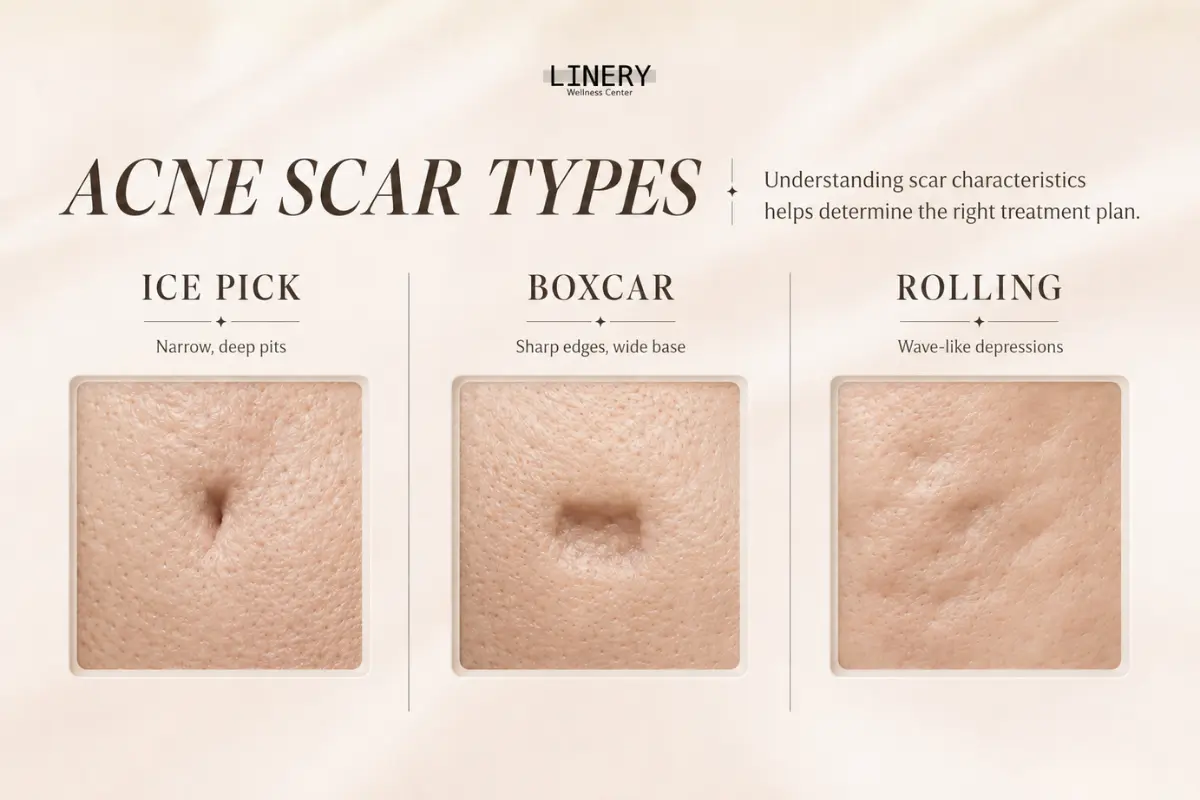
How Many Types of Acne Scars Are There? Ice Pick, Boxcar, and Rolling Scars Explained
Atrophic acne scars are commonly classified into three main types: ice pick, boxcar, and rolling scars. They differ in shape, width, depth, and underlying tissue structure, all of which can influence treatment selection.
Some people have more than one scar type in the same area, known as mixed acne scars. Scar shape alone may therefore not provide enough information; depth and underlying tissue characteristics should also be assessed.
What Is an Ice Pick Scar?
An ice pick scar has a relatively small surface opening but extends deeper into the skin. It often resembles a narrow puncture or small hole, so the visible opening may appear minor compared with the actual depth.
Assessment should consider the number, depth, and distribution of these scars, as deeper ice pick scars may require a more targeted approach rather than surface treatment alone.
What Is a Boxcar Scar?
A boxcar scar is a broader depression with relatively well-defined edges. Boxcar scars can be shallow or deep, and their appearance may vary across different areas of the face.
Both width and depth are important when planning treatment. A shallow boxcar scar may require a different approach from a deeper scar with more pronounced edges.
What Is a Rolling Scar?
A rolling scar is typically broader with softer, less defined edges, creating a wavy or uneven appearance across the skin. In some cases, underlying fibrous bands may tether the skin downward.
Rolling scars may become more noticeable under angled lighting because shadows emphasize the uneven skin surface. Assessment should therefore consider both surface texture and possible underlying tethering.
| Acne Scar Type | Typical Appearance | Common Depth | What Should Be Assessed |
|---|---|---|---|
| Ice Pick | Small, narrow opening | Often relatively deep | Depth and number of scars |
| Boxcar | Broad depression with defined edges | Shallow or deep | Width, edges, and depth |
| Rolling | Broad, soft-edged, wavy depression | Variable | Tethering and underlying tissue |
| Mixed Acne Scars | Multiple scar types together | Multiple depths | Proportion of each scar type |
Expert Insight: Scar classification is only the starting point. Two people with boxcar scars, for example, may have different depths and underlying structures, so treatment planning should consider the individual characteristics of each scar.
How to Identify Your Acne Scar Type by Appearance
The visible shape of an acne scar can provide an initial clue about its type, but self-assessment should not replace a professional evaluation. Scar depth, edge characteristics, and underlying tethering may not be fully visible in a mirror or photograph.
Viewing the skin in natural light or under angled lighting may make depressions and uneven texture easier to see, particularly when several scar types are present in the same area.
Small but Deep Pits May Resemble Ice Pick Scars
A small, narrow opening that appears to extend deeper into the skin may resemble an ice pick scar. These scars can look subtle from the front but become more noticeable under angled light.
The number, depth, and distribution of the scars should all be considered, as several ice pick scars may occur within the same area.
Broad Depressions With Defined Edges May Resemble Boxcar Scars
A broader depression with relatively clear edges may resemble a boxcar scar.
Boxcar scars can be shallow or deep, so width alone is not enough for assessment. The depth and surrounding skin surface should also be evaluated.
Wavy or Broad Depressions May Resemble Rolling Scars
Skin that appears wavy, uneven, or broadly depressed with less defined edges may resemble a rolling scar, especially when shadows become more visible under side lighting.
In some cases, this pattern may involve underlying fibrous tethering, which should be assessed before selecting a treatment approach.
Several Scar Patterns Together May Indicate Mixed Acne Scars
Many people have more than one type of acne scar in the same area. Ice pick, boxcar, and rolling scars may occur together across the cheeks or other acne-prone areas.
When several scar types are present, a single treatment approach may not address every scar equally. Identifying the type and depth of each pattern can help guide treatment planning.
| What You Notice | May Resemble | What Else to Assess |
|---|---|---|
| Small, narrow, deep pit | Ice Pick Scar | Depth and number of scars |
| Broad depression with defined edges | Boxcar Scar | Width and depth |
| Wavy surface with soft edges | Rolling Scar | Underlying tethering |
| Several patterns together | Mixed Acne Scars | Type and depth of each scar |
How Do Acne Scars Develop?
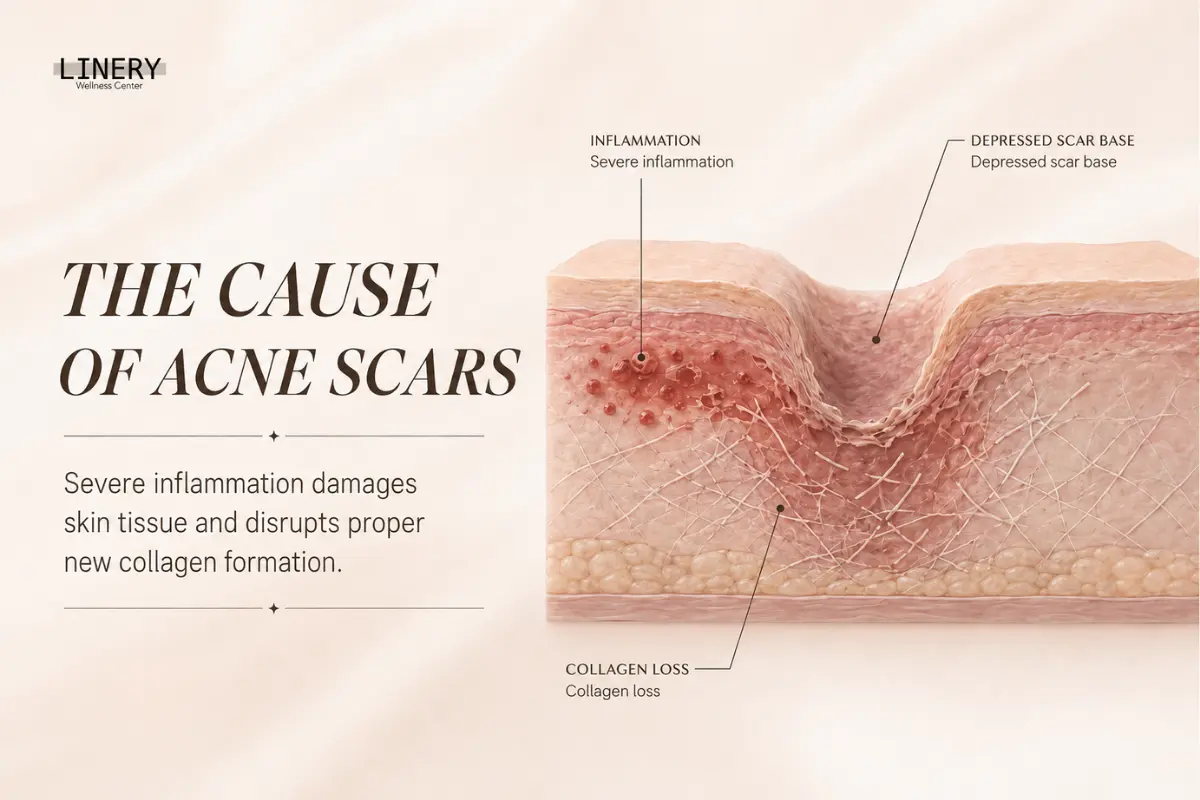
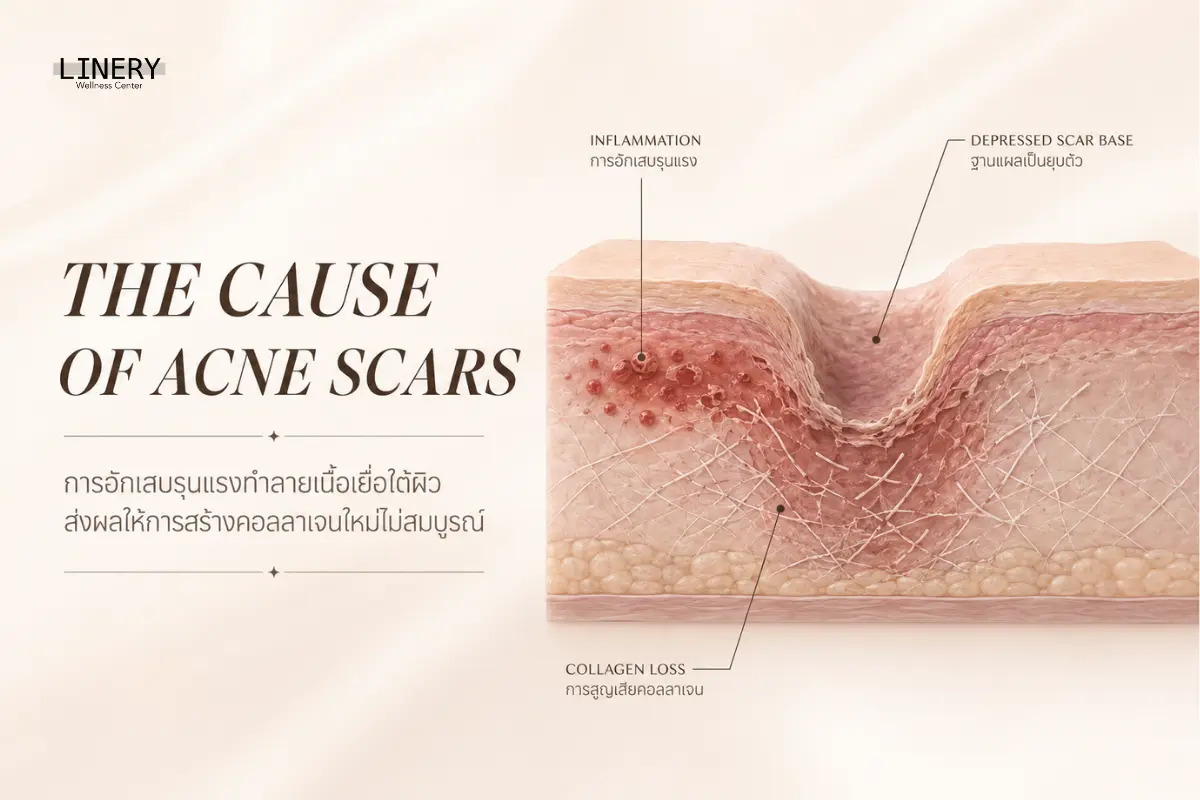
Acne scars can develop when inflammation damages skin tissue and the repair process restores collagen unevenly. Too little replacement tissue may lead to depressed scars, while excessive scar tissue may result in raised scars.
The risk is not determined by acne severity alone. The duration of inflammation, individual healing response, genetics, and repeated trauma to the affected area may also play a role.
How Does Acne Inflammation Affect Skin Structure?
When acne becomes inflamed, particularly when the inflammation extends deeper into the skin, tissue around the follicle may become damaged. The body then begins repairing the area by producing new collagen.
If the repaired tissue does not return to the original skin level, a depression may remain, resulting in atrophic scars such as ice pick, boxcar, or rolling scars.
Why Do Some People Develop Acne Scars More Easily Than Others?
Scarring varies between individuals, even when acne severity appears similar. Factors may include the depth and duration of inflammation, genetics, and the way each person’s skin heals.
Deep or recurrent inflammatory acne may increase the likelihood of structural skin changes, although not every acne lesion will necessarily leave a permanent scar.
Can Picking or Squeezing Acne Increase the Risk of Scarring?
Picking, squeezing, or applying excessive pressure to acne can cause additional tissue injury and inflammation, particularly when the lesion is still inflamed or located deeper in the skin.
This may increase the likelihood of post-acne redness or pigmentation and, in some individuals, may also contribute to the development of permanent acne scars.
Can Acne Scars Heal on Their Own?
Depressed acne scars caused by structural changes in the skin usually do not completely return to their original smooth appearance on their own. This differs from post-acne redness or pigmentation, which may gradually fade over time in some individuals.
When collagen has been lost or fibrous tissue is tethering the skin downward, the scar may remain visible as a depression or shadow even after active acne has resolved. Its appearance can still vary depending on skin hydration, overall texture, and lighting.
Do Shallow and Deep Acne Scars Change in the Same Way?
Shallow scars may appear less noticeable when the skin is well hydrated and overall texture improves, but this does not necessarily mean that the underlying scar structure has disappeared.
Deeper scars or those involving underlying tethering, such as certain ice pick scars or rolling scars, are generally less likely to improve substantially through natural skin repair alone.
Why Do Some Scars Look Better but Become More Visible Under Certain Lighting?
Lighting and shadows can significantly affect how acne scars appear. Side lighting can emphasize differences in skin level, making depressions more noticeable.
Direct or softer lighting may make the surface appear smoother. For this reason, acne scar progress is best compared using similar lighting, camera angles, and distances each time.
Can Creams and Skincare Remove Acne Scars?
Creams and skincare can help support skin tone, hydration, and overall skin quality, but they have limitations in correcting depressed acne scars caused by structural changes in the skin. This is particularly relevant for deeper scars or scars involving underlying tissue tethering.
If the main concern is an indentation or uneven skin level, skincare alone may not be able to fully restore the underlying scar structure.
What Can Skincare Help With?
Skincare products may improve hydration, support the skin barrier, and enhance overall skin texture. In some situations, better hydration and skin quality can make shallow irregularities appear less noticeable.
Certain products may also help manage uneven post-acne skin tone or support acne control, although the choice of ingredients should be appropriate for the individual skin type and level of sensitivity.
When Might Skincare Alone Not Be Enough?
Deeper scars, such as ice pick scars, deeper boxcar scars, or rolling scars associated with underlying tethering, involve structural changes that extend beyond the superficial skin layers.
In these cases, further assessment may be needed to determine whether procedures that stimulate skin remodelling, address tethering, or target individual scars should be considered according to the scar pattern.
What Acne Scar Treatments Are Available?
There are several treatment options for acne scars, and no single procedure is suitable for every scar pattern. Treatment selection should consider scar type, depth, treatment area, underlying tethering, skin condition, and individual response.
For people with multiple scar patterns, more than one technique may be considered. The underlying scar structure should be assessed before determining an appropriate treatment plan.
Microneedling
Microneedling uses fine needles to create controlled micro-injuries in the skin, stimulating the natural repair process and new collagen formation. It is commonly used to improve uneven texture and certain acne scar concerns.
Suitability depends on scar depth, treatment technique, and skin condition. If scars are particularly deep or involve underlying tethering, additional treatment approaches may need to be considered.
Subcision
Subcision is a procedure in which a needle or specialised instrument is introduced beneath the skin to release fibrous bands that tether a scar downward.
The technique targets structural attachment beneath the skin rather than simply resurfacing the upper layers. Assessment is therefore needed to determine whether tethering contributes to the visible depression.
TCA CROSS
TCA CROSS stands for Trichloroacetic Acid Chemical Reconstruction of Skin Scars. It involves applying a small amount of high-concentration TCA directly to individual scars to stimulate a localised repair response.
This is a targeted technique rather than a full-face chemical peel. Skin condition and the risk of irritation or post-inflammatory pigment changes should be considered before treatment.
Fractional Laser or Other Energy-Based Treatments
Fractional lasers and certain energy-based technologies may be used to stimulate collagen remodelling and improve the appearance of uneven scar texture.
Skin response, downtime, and the risk of post-inflammatory redness or pigmentation vary according to the device, energy settings, skin tone, and scar characteristics. Treatment should therefore not be selected based on the technology name alone.
Fillers and Other Adjunctive Treatments
In selected cases, injectable fillers may be considered to elevate depressed areas or used alongside other procedures when several structural concerns are present.
The type of filler, duration of effect, and suitability vary between individuals. These treatments require medical assessment and are not necessary for every type of acne scar.
Which Treatments May Suit Different Types of Acne Scars?
Acne scar treatment should be selected according to scar type, depth, edge characteristics, and underlying tethering rather than by procedure name alone. Ice pick, boxcar, and rolling scars have different structures and may respond differently to treatment.
In practice, one person may have several scar types in the same area. Each pattern should therefore be assessed before deciding whether the treatment should focus on resurfacing, releasing tethering, targeting individual scars, or combining several approaches.
| Acne Scar Type | What Should Be Assessed | Approaches That May Be Considered |
|---|---|---|
| Ice Pick Scar | Depth, number, and surface opening | Targeted techniques such as TCA CROSS or other approaches for deeper scars |
| Shallow Boxcar Scar | Width, depth, and scar edges | Microneedling, fractional laser, or resurfacing approaches |
| Deep Boxcar Scar | Depth and definition of the edges | Targeted techniques or a combination of treatments may be considered |
| Rolling Scar | Fibrous tethering beneath the skin | Subcision may be considered alongside resurfacing treatments |
| Mixed Acne Scars | Proportion and depth of each scar type | Combination treatment based on individual scar characteristics |
This table provides general guidance only. People with the same scar classification may still require different approaches depending on skin condition, skin tone, scar history, and individual response to treatment.
Ice Pick Scars Require Careful Assessment of Depth
Ice pick scars have small surface openings but may extend deeply into the skin. Broad resurfacing treatments alone may therefore have limited effects on some deeper individual scars.
Targeted approaches such as TCA CROSS may be considered in selected cases, depending on scar depth, number, and overall skin condition.
Boxcar Scars Should Be Assessed as Shallow or Deep
Shallow boxcar scars may be considered for treatments that stimulate collagen remodelling and improve surface texture, such as microneedling or fractional laser.
For deeper boxcar scars with more defined edges, additional assessment may be needed to determine whether resurfacing alone is sufficient.
Rolling Scars Require Assessment of Underlying Tethering
Rolling scars are often associated with fibrous attachments beneath the skin that contribute to a wavy or broadly depressed appearance.
In selected cases, techniques such as subcision may be considered to release tethering, either before or alongside treatments that improve surface texture.
Mixed Acne Scars May Require More Than One Approach
When ice pick, boxcar, and rolling scars are present in the same area, using a single procedure for every scar may not address all structural differences.
Treatment planning should therefore match the approach to each scar pattern rather than relying solely on one device or one treatment name.
Why Might Multiple Acne Scar Types Require Combination Treatment?
Multiple acne scar types may require more than one treatment approach because each scar can have a different structure and depth. Ice pick scars may involve deep focal depressions, rolling scars may be associated with underlying tethering, while boxcar scars can range from shallow to deep.
When several scar patterns occur in the same area, using one procedure for every scar may not address all concerns equally. Combination treatment therefore focuses on matching different techniques to the structural characteristics of each scar group.
What Is Combination Treatment?
Combination treatment refers to using more than one procedure within the same overall treatment plan. The procedures may be performed during the same visit or across separate sessions depending on skin condition and scar characteristics.
For example, someone with both rolling and boxcar scars may require assessment of underlying tethering as well as surface irregularity rather than relying on a treatment that addresses only one of these concerns.
Why Might a Single Treatment Not Address Every Scar?
Different procedures have different treatment targets. Some focus on stimulating collagen remodelling, others help release fibrous tethering, while certain techniques are designed to target deeper individual scars.
If ice pick, boxcar, and rolling scars are present together, applying the same technique to every area may produce an uneven response and may not address the underlying structure of each scar type.
What Should Be Considered Before Planning Combination Treatment?
Assessment should consider scar type, depth, number of scars, underlying tethering, current skin condition, active acne, and any previous response to procedures.
Not everyone requires multiple treatments. Combination treatment should be considered when the scar structure supports it, rather than simply adding more procedures without a clear clinical reason.
Which Types of Acne Scars May Be Suitable for Microneedling?
Microneedling is often considered for shallow to moderately depressed acne scars and uneven skin texture, particularly when the goal is to stimulate collagen remodelling and improve overall surface texture. Suitability still depends on the type, depth, and structure of the scars.
Microneedling does not work equally well for every acne scar pattern. Deeper scars, sharply defined depressions, or scars involving underlying tethering may require additional assessment and other treatment approaches.
Read More : Program Scar Regen
Shallow Acne Scars and Uneven Skin Texture
Relatively shallow scars, including certain boxcar scars or areas with generally uneven texture, may be considered for microneedling.
The aim is to stimulate the skin’s repair response and new collagen formation so that the surface gradually appears smoother over time rather than immediately filling the depression after treatment.
Deep Scars or Scars With Underlying Tethering
Deep ice pick scars, deeper boxcar scars, or rolling scars associated with fibrous tethering may not be fully addressed by microneedling alone.
When fibrous bands pull the skin downward, a technique that directly addresses tethering may need to be considered. Deep focal scars may also require a more targeted approach.
Can Microneedling Alone Treat Mixed Acne Scars?
When several acne scar types occur in the same area, microneedling may help improve overall skin texture but may not be the main treatment for every individual scar.
Assessment should identify which scars are shallow, which are deeper, and which involve tethering so that each technique can be matched more appropriately to the underlying scar structure.
Can Acne Scars Be Treated While Active Acne Is Still Present?
If active inflammatory acne is still present, it is often advisable to assess and control the acne before beginning acne scar treatment. New breakouts can create additional scars and may interfere with skin recovery after certain procedures.
This does not necessarily mean that every acne lesion must disappear before treatment. The decision depends on the amount of active inflammation, whether there are open or infected lesions, and whether the planned procedure is appropriate for the skin at that time.
Why Should Active Acne Be Controlled First?
If acne continues to recur, new scars may form even while existing scars are being treated. This can make long-term treatment planning and evaluation of progress more difficult.
Some scar procedures also create controlled skin injury to stimulate repair. Performing them over areas with significant active inflammation may increase irritation and may not be appropriate until the acne is better controlled.
What Types of Acne Should Be Reported Before a Procedure?
Tell your doctor if you have numerous inflamed lesions, pustules, painful or swollen acne, open wounds, crusting, or any area that may be infected.
You should also mention any acne medications, topical treatments, or recent procedures, as these factors may affect treatment selection and the appropriate timing of acne scar procedures.
How Many Acne Scar Treatment Sessions Are Needed Before Changes Become Noticeable?
There is no fixed number of acne scar treatment sessions because the treatment plan depends on scar type, depth, technique, and individual skin response. Some scars may begin to show changes during the treatment course, while deeper or mixed scar patterns may require a longer-term approach.
Collagen production and remodelling also take time after a procedure. Results should therefore be assessed at an appropriate interval for the treatment used rather than judged within the first few days.
| Factor | How It Can Affect the Treatment Plan |
|---|---|
| Scar type | Ice pick, boxcar, and rolling scars may respond differently |
| Scar depth | Deeper scars may require a more extensive treatment plan |
| Number and treatment area | Widespread scars may require a different approach from isolated scars |
| Underlying tethering | Structural attachment beneath the skin may need to be addressed |
| Treatment method | Each procedure has a different recovery and collagen-remodelling timeline |
| Individual skin response | Healing and improvement vary between individuals |
For mixed acne scars, progress should be evaluated by scar type because some patterns may respond differently even when they are treated within the same overall plan.
Treatment frequency or the number of procedures should not be increased simply to accelerate results. The skin requires adequate recovery time between sessions, and the appropriate interval depends on the procedure and individual skin condition.
How to Care for Your Skin Before and After Acne Scar Treatment
Preparing the skin before treatment and following appropriate aftercare can support the healing process. Recommendations vary depending on the procedure, such as microneedling, subcision, TCA CROSS, or fractional laser, so the instructions provided by your treating clinician should take priority.
How Should You Prepare Before Acne Scar Treatment?
Before treatment, inform your clinician about any medications, acne treatments, potentially irritating skincare products, and recent procedures. This information helps determine whether the skin is ready for treatment and whether any adjustments are needed.
Active inflammatory acne, open wounds, suspected infection, or significant irritation should also be reported. Avoid picking, squeezing, or aggressively exfoliating the treatment area before the procedure.
A history of hypertrophic scars or keloids should be disclosed as well, as this may influence treatment selection and risk assessment.
How Should You Care for Your Skin After Acne Scar Treatment?
Temporary redness, swelling, or irritation may occur depending on the procedure. Avoid picking, scratching, scrubbing, or using irritating products until the skin has recovered according to your clinician’s instructions.
Maintaining appropriate hydration and sun protection is also important during recovery, particularly for people who are prone to post-inflammatory hyperpigmentation.
If pain, swelling, redness, discharge, or other symptoms become unusually severe or worsen rather than gradually improve, contact the clinic or healthcare professional who performed the procedure for further assessment.
What Should Be Considered When Treating Acne Scars in Asian Skin?
Acne scar treatment in Asian skin should consider both scar structure and the skin’s pigment response. Some individuals may be more prone to post-inflammatory hyperpigmentation (PIH) after certain procedures.
This does not mean that acne scar procedures are unsuitable for Asian skin. However, treatment technique, energy level, treatment depth, and the interval between sessions should be selected according to the individual skin condition.
Skin Tone and a History of Post-Inflammatory Pigmentation Matter
People who tend to develop dark marks after acne, skin injury, or previous procedures should inform their clinician before treatment, as this history may help guide risk assessment.
In addition to scar type, factors such as skin tone, sensitivity, current skincare or medications, and previous procedures should be considered when planning treatment.
More Aggressive Treatment Is Not Always Better
Using higher energy or treating deeper does not necessarily produce a better outcome for every person. Excessive treatment may increase inflammation and prolong skin recovery.
The goal should be to match the treatment intensity to the scar type and depth while balancing potential improvement with recovery time and individual skin risk.
When Should Acne Scars Be Professionally Assessed?
Professional assessment is recommended when you are unsure whether the concern is post-acne discoloration or a true acne scar, when several scar types are present, or when previous treatments have not matched the scar pattern. A mirror or photograph may not reveal the full depth of a scar or underlying tissue tethering.
Assessment can help determine whether the main concern involves pigmentation, surface texture, scar depth, or structural tethering beneath the skin, all of which may influence treatment selection.
Further assessment may be particularly useful if you have:
- A combination of ice pick, boxcar, and rolling scars
- Deep scars that become more noticeable under angled lighting
- Active inflammatory acne alongside existing scars
- Previous acne scar procedures without a clear scar classification
- A history of hypertrophic scars or keloids
- Skin that tends to develop post-inflammatory hyperpigmentation
- A need for more than one treatment approach
The purpose of assessment is not simply to select a device or procedure. It should help identify the structure of each scar and which concern should be addressed first, allowing the treatment plan to be better matched to the individual skin condition.
Frequently Asked Questions About Acne Scar Treatment
Can Acne Scars Be Completely Removed?
In general, acne scar treatment should not be expected to restore perfectly smooth skin in every case. The goal is usually to reduce scar depth, improve texture, and make the scars less noticeable.
The degree of improvement depends on scar type, depth, treatment approach, and individual skin response.
Can Old Acne Scars Still Be Treated?
Acne scars that have been present for many years can still be assessed for treatment. Scar age is only one factor and should be considered together with depth, scar type, underlying tethering, and current skin condition.
Older scars do not necessarily mean that treatment is no longer possible, although the treatment plan may differ from that for newer or shallower scars.
Are Acne Scars and Enlarged Pores the Same?
No. Pores are normal skin structures that may become more visible because of oil production, ageing, or changes in skin quality. Acne scars result from structural tissue changes following acne inflammation.
Some areas may have both enlarged pores and acne scars, so distinguishing between the two is important before selecting treatment.
Can Acne Scars Come Back After Treatment?
A previously treated scar does not “return” in the same way that acne does. However, continued inflammatory acne can lead to new scars forming in the same or different areas.
Controlling new breakouts is therefore an important part of preventing additional acne scars.
Can the Same Treatment Be Used for All Acne Scars?
Not necessarily. When several scar types or depths are present, one procedure may not address every scar structure equally well.
Assessing different areas separately can help determine which approaches may be more suitable for ice pick, boxcar, rolling, or mixed acne scars.
Is Acne Scar Treatment Necessary?
Acne scar treatment is optional. If the scars do not cause concern or affect confidence, there is no requirement to undergo a procedure.
For those who want to improve skin texture, the first step should be identifying the scar type and understanding the expected benefits, recovery period, and limitations of each treatment option.
Conclusion: Acne Scar Treatment Should Begin With Identifying the Scar Type
Acne scar treatment should begin by distinguishing post-acne discoloration from true structural scarring. Ice pick, boxcar, and rolling scars differ in shape, depth, and underlying structure, so the same treatment approach may not be suitable for every scar.
When several scar types are present, assessment should consider scar depth, underlying tethering, skin condition, and any active inflammatory acne before considering microneedling, subcision, TCA CROSS, fractional laser, or a combination of treatments.
The goal of treatment is not to guarantee perfectly smooth skin in every individual. Instead, treatment should be matched to the scar structure to help reduce the visibility of depressions and improve overall skin texture appropriately.
Those who are unsure about their acne scar type or have several scar patterns can undergo an assessment at Linery Wellness Center in Thonglor before deciding on a treatment approach.
Results may vary from person to person. Please consult a physician for advice appropriate to your individual condition.
References
- American Academy of Dermatology. Acne scars: Signs and symptoms. View source
- American Academy of Dermatology. Acne scars: Consultation and treatment. View source
- Alster TS, et al. Microneedling in the treatment of atrophic scars: A systematic review of randomised controlled trials. PubMed
- Subcision in acne scarring: A review of clinical trials. PubMed
- Atrophic Postacne Scar Treatment: Narrative Review. PubMed